Difference Between Dji Osmo Action 6 and Dwarflabs Dwarf Iii Explained
The imaging industry has fragmented into highly specialized niches, moving away from the "one size fits all" philosophy of traditional DSLRs. Two of the most distinct products to emerge in recent years are the DJI Osmo Action 6 and the DwarfLabs Dwarf III. While both are categorized as cameras, they exist at opposite ends of the functional spectrum. The DJI Osmo Action 6 is a rugged, palm-sized powerhouse designed to survive wipeouts, deep dives, and extreme sports. In contrast, the Dwarf III is a smart, twin-lens digital telescope designed for long-range observation and astrophotography.
For a prospective buyer, the choice between these two devices isn’t about which takes "better" photos in a general sense, but rather which environment they intend to conquer. One is built for the chaotic, fast-moving energy of daylight adventures, while the other is crafted for the patient, still, and technical pursuit of the night sky and distant wildlife. This article provides an exhaustive analysis of how these two machines compare, their technical architectures, and which one fits specific creative workflows.
Understanding the DJI Osmo Action 6 Architecture
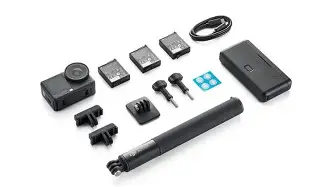
The DJI Osmo Action 6 represents the pinnacle of action camera evolution. It is built around the philosophy of "set it and forget it." Designed to be mounted on helmets, handlebars, or chest straps, its primary engineering goals are stabilization, durability, and wide-angle immersion. The device utilizes a large CMOS sensor capable of high dynamic range (HDR) video, specifically tuned to handle the harsh transitions between bright sunlight and deep shadows often found in outdoor sports.
A defining feature of the Action 6 is its RockSteady 4.0 and HorizonSteady technology. These electronic image stabilization (EIS) algorithms ensure that even during a mountain bike descent or a heavy surf session, the footage remains level and fluid. The camera’s physical build is almost entirely impervious to the elements, featuring a waterproof rating that allows for deep-sea diving without an external housing, and a specialized battery designed to operate in sub-zero temperatures. It is the tool of choice for vlogging, extreme sports, and any scenario where the camera itself might take a literal beating.
Exploring the DwarfLabs Dwarf III Smart Telescope
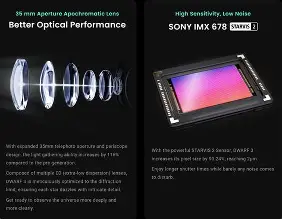
The DwarfLabs Dwarf III is a complete departure from the "action" category. It is an all-in-one smart telescope, often referred to as a "periscope" style digital camera. Unlike the wide-angle lens of an action camera, the Dwarf III features a dual-lens system: one wide-angle lens for locating subjects and a powerful telephoto lens for capturing them. It is designed to be placed on a tripod and controlled entirely via a smartphone app.
The magic of the Dwarf III lies in its internal computational photography. For astrophotography, it uses automated star-tracking and "stacking" technology. It can identify celestial bodies like the Orion Nebula or the Moon, track them as the Earth rotates, and take multiple long-exposure shots, merging them into a single high-detail image. For terrestrial use, it acts as a high-powered digital binocular, allowing birdwatchers or surveillance professionals to view subjects from hundreds of yards away with clarity that an action camera could never achieve. It is a device for the patient observer who wants to bridge the gap between their location and a distant point of interest.
Detailed Comparison: Specs and Performance
To understand the fundamental gap between these two devices, one must look at their optical and processing priorities. The DJI Osmo Action 6 focuses on frame rates and field of view, while the Dwarf III focuses on focal length and automated tracking.
| Feature | DJI Osmo Action 6 | DwarfLabs Dwarf III |
|---|---|---|
| Primary Use Case | Action, Vlogging, Sports | Astrophotography, Wildlife, Long-range |
| Lens System | Single Ultra-Wide (approx. 155° FOV) | Dual Lens (Wide + Telephoto) |
| Stabilization | Electronic (RockSteady/HorizonSteady) | Internal 2-axis Pan/Tilt Tracking |
| Waterproofing | Up to 18m (Native) | Weather resistant (Not submersible) |
| App Integration | DJI Mimo (Editing and Live View) | DwarfLabs App (Remote Control/Tracking) |
| Weight | Approx. 145g | Approx. 1.3kg |
| Maximum Resolution | 4K at 120fps | 4K at 30/60fps (Sensor optimized for light sensitivity) |
Optical Performance and Focal Length
The DJI Osmo Action 6 uses a fixed focal length lens with an extremely wide field of view. This "fisheye" effect is intentional, as it captures the peripheral environment, making the viewer feel like they are part of the action. It excels in "close-quarters" filming. If you are holding the camera at arm's length or mounting it to a car hood, the Action 6 provides a sharp, expansive view of everything in front of it.
Discover deals on Cameras & Photography — updated daily.
See Deals →The Dwarf III, however, is built for reach. Its telephoto lens provides the equivalent of a massive zoom seen on professional spotting scopes. While the Action 6 would show a bird on a distant branch as a tiny, indistinguishable speck, the Dwarf III can zoom in to reveal the texture of the bird’s feathers. This makes it a specialized tool for birding, safari photography, and astronomical observation where the goal is to make the distant appear near.
Stabilization vs. Tracking
Stabilization in the Osmo Action 6 is reactive. It uses gyroscopes to detect vibration and crops the image digitally to smooth out the movement. This is perfect for handheld use or high-vibration environments like a motorcycle dashboard. However, you cannot tell an Action 6 to "follow that eagle" or "stay pointed at Mars."
The Dwarf III uses active tracking. It features internal motors that physically move the imaging components to follow a subject. In "AI Track" mode, it can lock onto a person, a boat, or a planet and keep them centered in the frame automatically. This is a game-changer for solo creators who want a "robotic cameraman" or for astronomers who need to compensate for the rotation of the sky during long exposures.
Pros and Cons Analysis
DJI Osmo Action 6
- Pro: Unmatched Durability - Can withstand drops, dust, and deep water without a sweat, making it the most reliable choice for rough environments.
- Pro: High Frame Rates - Ability to film in 4K at 120fps allows for beautiful slow-motion captures of waves, jumps, or fast-paced sports.
- Pro: Dual Touchscreens - Front and rear screens make it incredibly easy to frame shots when the camera is pointed at the user, a necessity for modern vloggers.
- Pro: Quick-Release Ecosystem - The magnetic mounting system allows for near-instant transitions between different mounts and accessories.
- Con: Limited Low Light - Small sensors and wide lenses struggle in very dark environments, often producing "noisy" or grainy footage at night.
- Con: No Optical Zoom - Digital zoom is available, but it quickly loses quality, making it poor for capturing distant subjects.
DwarfLabs Dwarf III
- Pro: Revolutionary Astrophotography - Simplifies the complex world of space photography into a few taps on a smartphone, making deep-sky imaging accessible to beginners.
- Pro: Intelligent Subject Tracking - The AI-driven tracking is excellent for keeping moving animals or distant objects in the center of the frame.
- Pro: Compact for its Capability - While heavier than an action camera, it is significantly smaller and more portable than a traditional telescope and equatorial mount setup.
- Pro: Dual-View Mode - Allows the user to see the wide-angle context while simultaneously capturing a high-zoom telephoto image of the subject.
- Con: Not Fit for Action - The motor-driven tracking is too slow for fast-paced close-up movement, and the device is too fragile for rugged sports.
- Con: Dependent on Smartphone - Without a high-quality connection to a phone or tablet, the device is virtually impossible to operate effectively.
Real-World Use Cases
The Weekend Adventurer and Vlogger
If your primary goal is to document your hikes, your snowboarding trips, or your travel journeys for social media, the DJI Osmo Action 6 is the clear winner. Its portability means it fits in a jacket pocket, and its "instant record" features mean you won't miss a fleeting moment. It is designed for the creator who is the protagonist of their own story, moving through the world at high speed.
The Backyard Astronomer and Nature Watcher
If you find yourself staring at the craters of the moon or trying to identify rare birds in a distant marsh, the Dwarf III is an indispensable tool. It replaces the need for heavy, complicated telescope rigs. A user can set it on a balcony, go inside to their living room, and watch a live feed of the stars on their tablet while the Dwarf III handles the cold and the technical tracking outside. It is for the observer who wants to see what the human eye cannot reach from a distance.
Buying Guide: Which One Should You Choose?
Choosing between these two depends on answering three fundamental questions about your photography style.
1. Where is the camera positioned?
If the camera is going to be attached to you, your bike, your surfboard, or a selfie stick, buy the DJI Osmo Action 6. It is designed to move with you. If the camera is going to sit on a tripod or a flat surface while you stand back, the Dwarf III is the superior choice.
2. What is your subject?
Is your subject yourself, your friends, or the landscape immediately surrounding you? The wide-angle lens of the Action 6 is the right tool. Is your subject a mile away or 50 million miles away in space? The telephoto power and star-tracking of the Dwarf III are mandatory.
Discover deals on Cameras & Photography — updated daily.
View Offers →3. What are the environmental conditions?
Dusty trails, rainy football matches, and underwater reefs require the DJI Osmo Action 6. It is built to survive "the mess." The Dwarf III, while weather-resistant, is a precision instrument. It prefers clear nights, stable ground, and careful handling. It is not something you want to drop on a trail or submerge in a lake.
Technical Software Experience
The software experience for these two cameras is vastly different. DJI’s Mimo app is focused on post-production—helping users trim clips, apply color LUTs (like D-Log M), and share "stories" quickly. The camera itself is autonomous; you can do almost everything via the dual touchscreens without ever opening the app.
The DwarfLabs experience is centered on the control interface. Because the Dwarf III lacks a built-in screen, the app is your viewfinder, your controller, and your workstation. The app includes a database of thousands of celestial objects; you simply select "Saturn," and the camera’s motors whirr into life to find it. This level of automation is what makes the Dwarf III a "smart" device rather than just a camera.
Conclusion
The DJI Osmo Action 6 and the DwarfLabs Dwarf III represents two different philosophies of seeing the world. The Action 6 is about the "here and now," capturing the visceral, high-octane reality of a human being in motion. Its strengths lie in its indestructible nature and its ability to smooth out the chaos of a moving world. It is a tool of participation.
The Dwarf III is a tool of observation. It is about the "there and then," pulling distant, unreachable subjects into focus through the power of optics and artificial intelligence. It turns a smartphone into a window to the cosmos and a high-powered lens for the natural world. It celebrates the details that are otherwise invisible to the naked eye.
Ultimately, these cameras do not compete; they complement. Many dedicated outdoor creators may find themselves owning both: an Action 6 for the journey to the mountain peak, and a Dwarf III to capture the stars once they set up camp for the night. By understanding these differences, you can ensure that your investment aligns with the stories you want to tell and the sights you want to see.