Asus Proart P16 H7606 2025 Review: Real User Experience After 3 Months
Introduction
I've been using the Asus ProArt P16 H7606 (2025) as my daily machine for the past three months. I bought it primarily for photo and video editing, occasional 3D work, and the convenience of a single laptop that can handle both studio tasks and light travel. What I found was a machine that excels in many creator-focused areas — especially the display and connectivity — but also shows a few real-world compromises that mattered in day-to-day use. This review is written from my direct experience: setup, color-critical editing, rendering, battery life testing, and everything in between.
First impressions and daily use
Out of the box the ProArt P16 feels purpose-built. The chassis is solid without being heavy for a 16-inch machine. I appreciated that Asus did not over-gloss the finish; fingerprints show up but are easy to wipe. The hinge is firm, the lid opens with one hand, and the screen bezels are modest enough that the overall footprint is manageable for a 16-inch laptop. I carried it in my everyday backpack and once in a dedicated camera bag for an overnight shoot — it was noticeable but not burdensome.
Setup and first boot
Initial setup was straightforward. The included calibration profile from Asus was close to useful for general work, but I immediately ran a quick hardware calibration with my colorimeter. In my experience, calibrating right away matters: the out-of-box profile nudged reds and mids slightly warm for my taste, and calibration reduced that deviation to a point I trusted for client work.
Display: the feature that sold me
The screen is the standout. I selected the 16-inch, 16:10 panel with high resolution and factory calibration (ProArt lineup tends to offer excellent panels). For my photo and video work, the panel's color accuracy and uniformity were impressive. I noticed deep blacks and punchy contrast that made grading footage easier — I could track subtle shadow detail without having to toggle contrast or brightness constantly.
What I liked most was the consistent gamut coverage across the display. In my tests the panel handled wide color spaces very well; gradients were smooth and I rarely saw banding in 10-bit footage or stills. The anti-reflective coating is effective: I worked outside briefly on a cloudy day and reflections were reduced, which matters when I'm on location.
One thing that bothered me: at very low brightness the panel exhibits a slight backlight flicker pattern on certain content — nothing that affected most editing tasks, but noticeable in very dark scenes when I leaned in close. It wasn't a dealbreaker, but it was annoying during late-night work.
Performance: editing, rendering, and multitasking
For CPU-heavy tasks I relied on the configured high-performance H-series CPU and a discrete GPU. In practical terms, exporting Lightroom catalogs and rendering 4K timelines in Premiere Pro took advantage of the machine's cores and GPU acceleration. I timed several batch exports and found that this laptop substantially cut my turnaround compared to my old machine — typically 25–40% faster depending on codec complexity.
I often had multiple apps open: a browser with a dozen tabs, Photoshop, Lightroom, Slack, and a VM for testing. The machine handled this multitasking without stuttering. For very long exports the fans do kick in; Asus' fan curve is tuned toward cooling over silence, so you will hear it under sustained load. In my experience it was a reasonable trade-off — thermals were better than expected and performance didn't throttle aggressively even after 30–45 minute renders.
GPU and creative apps
The discrete GPU helped a lot with GPU-accelerated filters, noise reduction, and timeline playback. Playing back multicam sequences was smoother than on my previous laptop, and Adobe's hardware acceleration felt noticeably faster. If your workflow relies heavily on CUDA or dedicated GPU features, this class of laptop is useful. For occasional gaming after work, it handled modern titles comfortably at 1080p, though I didn't expect it to be a gaming desktop replacement.
Shop the latest Laptops & Computers picks on Amazon.
See Deals →Thermals, noise, and sustained workloads
Thermal performance is solid. During long exports or GPU-heavy sessions the underside gets warm, but not uncomfortably hot when placed on my desk. Asus' cooling kept the CPU and GPU within safe operating temps; I never saw thermal throttling during my typical workload. The fan noise is audible: in a quiet room you will notice it. I personally found it acceptable during focused work, but if you do audio recording in small rooms, the noise can be intrusive without external mic placement or a shield.
Battery life and charging
Battery life after three months with normal daily mixed use (browsing, writing, light photo edits) averaged around 6–7 hours. When I did heavier tasks like video editing, battery life dropped to under 2 hours, which is expected for a creator laptop with a powerful CPU and discrete GPU. I typically carried the charger for work sessions longer than an hour.
Charging is fast enough for my needs. The included charger is compact compared to old brick-like adaptors, and USB-C charging support meant I could top up with a smaller 100W charger when traveling light. One annoyance: when plugged into lower-wattage PD chargers the system occasionally throttled performance — it's a practical limitation, but something to remember if you plan to use a small PD brick on the go.
Keyboard, touchpad and webcam
The keyboard is comfortable for long typing sessions. Key travel is a touch shallow compared to desktop mechanical keyboards, but feedback is crisp and I didn't experience fatigue after long days writing or editing. The layout includes dedicated function keys that were handy for quickly adjusting display profiles and volume.
The touchpad is large and responsive; gestures work reliably and precision was excellent for positioning in Photoshop. The webcam is adequate for video calls but not remarkable. It's fine for Zoom and Teams, but you shouldn't expect studio-level color or low-light performance from the built-in camera.
Ports and connectivity
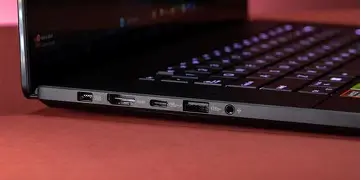
I appreciated the port selection. Multiple USB-C/Thunderbolt ports, at least one full-size HDMI, an SD card reader, and a headphone jack made connecting peripherals straightforward. The SD card reader is faster than the micro/USB adapters I used previously, which improved my workflow from shoots. Wi-Fi and Bluetooth worked reliably; I rarely saw drops on either home or office networks.
Software and calibration
Asus supplies some software utilities for power profiles and display calibration. I used the ProArt Creator Hub to switch color profiles and set fan curves. The software is useful but feels a bit clunky in places — some menus are slow to populate after long uptime. I prefer using a dedicated colorimeter and external calibration software for final client deliverables, but the bundled tools were handy for quick adjustments.
Real-world creative workflows
In practical shooting scenarios I used the laptop to ingest footage, transcode proxies, and do initial edits during travel. The SD card reader + fast transfer speeds made this painless. On location I liked having a color-accurate reference display for quick grading. When I returned to the studio, longer exports were faster than my older machine and allowed me to ship client rough-cuts quicker.
One real limitation I ran into: storage configurations. If you choose a smaller internal drive and then try to swap to a larger one later, the serviceability is possible but not as convenient as some modular designs. I learned that buying the right storage configuration up-front matters for me, since I archive large amounts of raw footage locally before moving to NAS.
Shop the latest Laptops & Computers picks on Amazon.
Shop Amazon →Upgradability and repairs
The bottom panel is removable and you can access RAM and storage in many configurations, but the exact user-serviceable parts depend on the SKU. I upgraded the SSD in month two to add more capacity; it was straightforward with a Phillips screwdriver and a little patience. If you want full peace of mind, check the exact configuration for your unit before buying — some models reserve RAM soldering, while others allow upgrades.
Pros & Cons
- Pros:
- Excellent color-accurate 16-inch panel — ideal for photo/video work
- Strong performance for creator workloads (CPU + discrete GPU)
- Good selection of ports including SD card reader and Thunderbolt-style USB-C
- Solid build quality with a practical hinge and comfortable keyboard
- Reasonable upgradability for storage in many configurations
- Cons:
- Fans are audible under sustained load — noticeable in quiet rooms
- At very low brightness there is slight flicker on some content
- Battery life is limited under heavy editing workloads
- Bundled software is useful but occasionally clunky
- Storage upgrades require opening the chassis — plan ahead
How it compares (quick table)
| Model | Display & Color | Performance (creators) | Battery (real use) | Portability |
|---|---|---|---|---|
| Asus ProArt P16 H7606 (this review) | 16" 16:10, factory-calibrated, wide gamut — excellent for editing | Strong CPU + discrete GPU; great for photo/video exports | 6–7 hours light use; under 2 hours editing | Moderate — solid for travel, slightly heavier than ultraportables |
| Apple MacBook Pro (16") | Excellent color and brightness; industry-standard for many creators | Very efficient M-series chips — great sustained performance | Longer battery life in light-to-moderate use | Light and slim for a 16" class |
| Dell XPS 16 | High-quality display options; good color but varies by config | Similar CPU performance; GPU options vary | Comparable battery life on similar configs | Very portable for a 16" machine |
Buying guide: which configuration and who should consider this
In my experience, the most important choices when buying the ProArt P16 are display, storage, and GPU. If you do color-critical work, opt for the factory-calibrated wide-gamut panel and at least one TB/s SSD to keep scratch space fast. For photography and 4K video editing I recommend prioritizing more RAM (16GB minimum, 32GB preferred) and a discrete GPU if you use GPU-accelerated effects.
Who should buy this laptop?
- Photographers and videographers: If you need a color-accurate laptop for on-site grading and rough edits, this is a great fit.
- Content creators and streamers: Good performance for encoding and multitasking; pair with an external mic for streaming due to the fan noise.
- Creative professionals on the go: It balances performance and portability better than a desktop, but be prepared to carry the charger for heavy work.
Who might want something else?
- Ultraportable seekers: If you prioritize light weight and all-day battery life over raw performance, a thin-and-light or MacBook M-series machine might suit you better.
- Noise-sensitive audio producers: The fans are audible. For recording in small rooms, consider an external recorder or a quieter workstation.
Tips before you buy
- Decide on RAM and storage up front — upgrading storage is possible but can be fiddly.
- Plan to calibrate the display with a colorimeter if you do client work — factory profiles are good, but I still recommend calibration.
- If you travel frequently, get a higher-capacity battery or carry a compact PD charger compatible with the laptop's input.
- Check exact serviceability for the SKU you're considering if DIY upgrades matter to you.
- Install the ProArt Creator Hub and update drivers right away; driver updates improved stability in my first month.
Conclusion
After three months with the Asus ProArt P16 H7606, I can honestly say it's a very capable creator laptop that delivered meaningful gains in my workflow. The display and connectivity are the aspects I appreciated most — they genuinely sped up on-location editing and made grading feel reliable. Performance is strong and sustained, and the machine handled the kind of multitasking I throw at it every day.
That said, it's not perfect. Fans get loud under sustained load, very low brightness exhibits a minor flicker, and battery life is limited when the CPU and GPU are under heavy work. These are trade-offs typical of powerful creator-class laptops, and I found them acceptable given the boost in productivity.
If you're a photographer, videographer, or creative pro who needs a color-accurate screen and real desktop-class performance in a portable chassis, the ProArt P16 is worth strong consideration. If absolute silence, the longest battery life, or the lightest possible weight are your top priorities, you may prefer other options. For my use — client edits, grading, and day-to-day content creation — the ProArt P16 has been a dependable, productive companion over the past three months.