Adata Sd820 External Ssd Specs, Features, and Value: Is it worth the price tag?
Category: Laptops
Introduction
The ADATA Sd820 external SSD targets users who want faster portable storage than a spinning hard drive without the complexity of installation. External SSDs have become mainstream tools for laptop users, creatives, and field professionals who need fast, pocketable drives for editing, backups, and transporting large files. This article examines the ADATA Sd820’s key specifications and features, evaluates real-world performance and durability, compares it to peers, and offers a buying guide that outlines who should consider this drive and why. The goal is to give an objective, practical assessment so buyers can decide whether the Sd820 delivers the performance and value they need.
What the Sd820 claims and an at-a-glance spec summary
ADATA positions the Sd820 as a portable external SSD that blends compact design with solid transfer speeds and broad compatibility. Below is a condensed summary of the most relevant user-facing specifications and features buyers typically care about.
| Specification | Typical Value / What to expect |
|---|---|
| Interface | USB-C (USB 3.x family — check exact Gen on the retailer page), bus-powered |
| Form factor | Compact, pocket-sized external enclosure |
| Capacities | Commonly available in 256GB, 512GB, 1TB (availability varies by market) |
| Performance (sequential) | Marketing numbers typically indicate 'up to' several hundred to around 1,000 MB/s — real-world depends on host port and file sizes |
| Durability | Shock-resistant internal SSD with robust enclosure; not necessarily IP-rated for water/dust unless specified |
| Compatibility | Windows, macOS, many Linux distributions; plug-and-play over USB-C/USB-A (adapter) |
| Security | Software-based encryption support; check model for hardware encryption |
| Warranty & Support | Manufacturer warranty (commonly 3 years for ADATA SSDs — verify for the Sd820) |
Detailed product review and analysis
Design and build quality
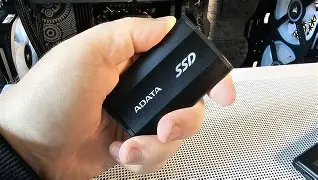
The Sd820 follows ADATA’s approach of making compact, travel-friendly drives that don’t overemphasize flashiness. The enclosure is typically constructed from plastic or a mix of plastic and metal to keep weight down while providing reasonable rigidity. For laptop users who toss drives into bags alongside chargers and accessories, the Sd820’s rounded corners and small footprint mean it fits easily into a pocket or small pouch.
Physical connectors are important in daily use. The Sd820’s USB-C port (with a USB-C to USB-C cable and usually a USB-C to USB-A adapter included) covers both modern laptops and older machines. A snug connector and short cable reduce the risk of accidental disconnects during file transfers. Buyers should check the cable length and whether the included cable supports the advertised transfer speed — cheap cables can bottleneck performance.
Performance: real-world vs. claimed speeds
ADATA’s marketing often quotes “up to” sequential read/write figures that assume an optimal host connection and theoretical limits of the internal SSD. In practice, external SSD performance depends on several variables:
- Host USB controller and version (USB 3.2 Gen 2 vs. Gen 1 makes a big difference)
- Drive capacity (higher-capacity SKUs sometimes have faster sustained speeds)
- File sizes and whether transfers are large sequential files or many small files
- Thermal throttling under sustained load
For creative professionals moving large video files, the Sd820 should offer noticeable improvements over external HDDs and older USB flash drives — faster file transfers and snappier behavior when editing directly from the drive. For laptop users who need fast project loads, the day-to-day experience will be influenced by the laptop’s USB port and whether the machine supports the high-speed USB mode the drive expects.
Sustained performance and thermal behavior
One common real-world consideration with compact external SSDs is heat. Small enclosures have limited surface area for heat dissipation, and under prolonged transfers (for example, copying many GBs at once), some drives throttle to protect the NAND and controller. The Sd820’s thermal performance will affect long backup sessions and extended video transfers. Users who plan to move large datasets regularly should confirm how the Sd820 handles sustained loads in third-party benchmarks or reviews, or consider drives with metal housings and active cooling solutions if necessary.
Durability and reliability
For users who travel with a laptop, durability is a key consideration. External SSDs are inherently more resilient than HDDs because they have no moving parts; the Sd820’s resistance to shock and vibration makes it suitable for mobile workflows. However, “suitable” differs from “rugged.” Unless the model is explicitly rated for drops, water, and dust ingress, it should not be treated as a rugged field drive. Backups remain crucial: even reliable flash can fail, so the Sd820 is best used as a fast transport or working drive complemented by a separate backup solution.
Discover deals on Laptops & Computers — updated daily.
View Offers →Software, features, and security
ADATA typically bundles or provides optional software for basic management, firmware updates, and sometimes backup utilities. Encryption support is important for laptop users handling sensitive data; some external SSDs use software encryption that is platform-agnostic, while others offer hardware-based AES encryption tied to a specific utility. Buyers should verify whether the Sd820’s encryption is hardware-based or software-based and whether it’s readily supported on macOS and Windows without vendor lock-in.
Compatibility and ecosystem
One of the Sd820’s strengths is likely to be broad compatibility. USB-C with backward compatibility to USB-A means it works with modern ultrabooks, Windows laptops, and desktop ports. USB Power Delivery is generally not required — these drives are bus-powered — but some laptop USB-C hosts limit USB performance in low-power modes, which can affect speed. For Apple users, reformatting to APFS or exFAT may be necessary depending on use; ADATA’s software ecosystem often favors Windows, so Mac users should confirm tooling for firmware updates and encryption.
Pros & Cons
Pros
- Compact, pocketable form factor that fits modern laptop workflows
- Noticeable performance improvement over mechanical external drives for file transfers and editing
- USB-C interface gives compatibility with a wide range of laptops and tablets
- Lower power draw and bus-powered operation — no external power brick
- Good option for users who need a fast working drive for photos, video clips, and project files
Cons
- Actual speeds depend heavily on the host USB controller and cable — may not reach marketing numbers on older ports
- Small enclosure may heat up during long sustained transfers, leading to throttling
- May lack rugged IP-rating — not suitable as the only backup in harsh environments
- Value proposition depends on current market prices and competing models with similar features
Comparison: Sd820 vs common portable SSD alternatives
The table below compares the Sd820 against widely known external SSD options. Numbers are representative ranges for consumer-level external SSDs — actual model specifications vary by capacity and revision. Use this comparison to understand where the Sd820 fits relative to common choices.
| Drive | Typical Interface | Typical Max Sequential Read | Capacities | Ruggedness | Common Use Case |
|---|---|---|---|---|---|
| ADATA Sd820 | USB-C (USB 3.x) | Several hundred MB/s to ~1,000 MB/s (varies) | 256GB–1TB (market dependent) | Shock-resistant, consumer-grade (check model) | General fast portable storage for laptops and editors |
| Samsung Portable SSD (e.g., T7) | USB-C (USB 3.2 Gen2) | Up to ~1,050 MB/s | 500GB–2TB | Compact, not IP-rated | Reliable day-to-day fast storage, strong brand support |
| SanDisk Extreme Portable SSD | USB-C | Up to ~1,050 MB/s (varies) | 500GB–4TB | IP55 dust/water resistance in many SKUs | Fieldwork for photographers, outdoors use |
| Crucial X8 | USB-C | Up to ~1,050 MB/s | 500GB–2TB | Solid aluminum casing, drop-tested | Robust portable storage with consistent performance |
Real-world use cases: who benefits from the Sd820?
Understanding typical buyer priorities helps clarify whether the Sd820 is a sensible choice:
- Students and office users: Those who need a simple, fast external drive for document archives, video projects, and backups will find the Sd820 responsive and convenient. The compact size is convenient for backpacks.
- Photographers and hobbyist videographers: For moving large RAW photo archives and short video clips between a laptop and desktop, the Sd820 is faster than a portable HDD and much lighter. For heavy, on-location multi-hour shoots, consider a drive with an explicit rugged rating.
- Content creators and editors: Users who edit directly from external storage should confirm sustained transfer speeds and thermal throttling behavior. The Sd820 can be suitable for smaller projects but may not match higher-end NVMe external enclosures for prolonged 4K workloads.
- Gamers: Portable SSDs reduce load times for large game installs when used with compatible consoles or PCs. Gamers who travel with a gaming laptop may appreciate the Sd820’s speed and size.
- Backup and archival: The Sd820 is a good option for frequent incremental backups. As always, it should be part of a multi-tier backup strategy rather than the sole archive.
Buying guide: what to check before purchasing an external SSD like the Sd820
External SSDs now come in many flavors; the right choice depends on use case and priorities. Before purchasing the Sd820 or any portable SSD, consider these points:
1. Confirm the interface and host port
Check whether the laptop supports USB 3.2 Gen 2 or only Gen 1. A Gen 1 port caps transfer speed at around 5 Gbps (~500 MB/s theoretical), which can limit the SSD’s potential. If the Sd820’s marketing figures rely on a Gen 2 connection, ensure the host has the matching port or a USB-C port with an appropriate controller.
2. Look at sustained transfer performance, not just peak numbers
Small burst transfers and single-file sequential reads may hit the peak stats, but sustained copying of many gigabytes can expose thermal throttling. Read third-party endurance and sustained-transfer tests to understand real-world behavior.
3. Capacity and price per gigabyte
Choose capacity based on workflow: photo editors often start at 1TB, video editors frequently prefer 2TB or more. Compare price per GB with other reputable models — sometimes a slightly higher upfront price buys a more consistent experience.
4. Durability and warranty
If travel and field use are routine, confirm whether the drive has any drop, shock, or water-dust resistance rating. Also confirm the warranty period and what it covers; longer warranties provide extra peace of mind for long-term use.
Looking for the best Laptops & Computers deals on Amazon?
View Offers →5. Security and backup software
Encryption is essential for sensitive data. Verify whether encryption is hardware-based and cross-platform friendly. Also check whether ADATA offers backup software that meets the buyer’s needs or whether third-party tools will be required.
6. Cable quality and included accessories
Cheap or incorrect cables can bottleneck speed. Ensure the drive comes with a cable rated for its highest advertised speed and that an adapter is included if you need USB-A compatibility.
7. Real-world reviews and firmware support
Check independent reviews for thermal and reliability observations. Also confirm whether the vendor provides firmware updates and easy utilities — a neglected firmware update can leave performance or compatibility on the table.
Value assessment: is the Sd820 worth the price tag?
Value depends on what the buyer prioritizes. For a laptop user who needs a compact fast drive for daily transport of project files, the Sd820 will likely check the right boxes: it's faster and far more durable than HDD options, and it provides a better mobile experience. If the Sd820 is priced competitively against established models with similar performance and warranty, it represents a solid value.
However, if competing drives with similar throughput and better thermal behavior, longer warranties, or stronger software ecosystems are available at the same or lower price, buyers may prefer those alternatives. The Sd820’s value hinges on local pricing, available capacities, and whether ADATA’s specific combination of design, bundled accessories, and warranty meets the buyer’s needs.
Final considerations and practical tips before purchase
- Always verify the exact interface generation on the product page and match it to the laptop’s port for full performance.
- Look for recent third-party benchmarks focusing on sustained transfers if the workload includes large continuous file copies (video projects, large backups).
- Back up critical data in multiple places; treat external SSDs as fast working copies rather than the only archive.
- If the drive will be used in hot environments or for long continuous transfers, consider a metal-cased model or an external enclosure with better thermal dissipation.
- Keep an eye on bundled cables — a rated cable is as important as the drive itself for achieving top speeds.
Conclusion
The ADATA Sd820 external SSD is positioned as a compact, fast, and convenient option for laptop users, creatives, and travelers who need higher speeds than mechanical drives. For everyday tasks—project file transport, photo libraries, and working backups—the Sd820 delivers the advantages that make external SSDs compelling: speed, portability, and lower fragility.
Whether it is worth the price tag depends on the specific SKU, the buyer’s host hardware, and available alternatives at the moment of purchase. If the Sd820’s retail price sits comfortably below or in line with comparable models while offering the advertised speed and a reliable warranty, it is a worthwhile option. Buyers with sustained heavy workloads, professional 4K editing needs, or who operate in harsh environments should verify sustained performance and ruggedness before committing. As with any storage purchase, matching the drive’s strengths to concrete use cases and confirming compatibility ensures the best long-term value.